01 / Routines

Set it once. It runs forever. Even while you sleep.

Describe it — it gets built — it runs on schedule — you wake up to the result. It is the same idea as running an AI agent on your Mac without the terminal.

Step 01

Describe it in plain English.

Create a routine

Create a routine

Describe what you want — we'll handle the rest.

Looks good — press Continue when ready.Continue

Morning briefing

Weekday at 8am with inbox & calendar

When my Mac wakes up

Quick agenda from calendar

Step 02

Routines builds the automation.

Designing your routine

NameMorning Briefing
Schedule
Weekdays · 8:00 AM0 8 * * 1-5
Connectors
Gmail Calendar Slack
IntelligenceBalanced
PromptRead my inbox and calendar, then post a briefing to Slack…
Ready to save

Set it once

A prompt, a schedule, the accounts it can touch. That's the whole setup.

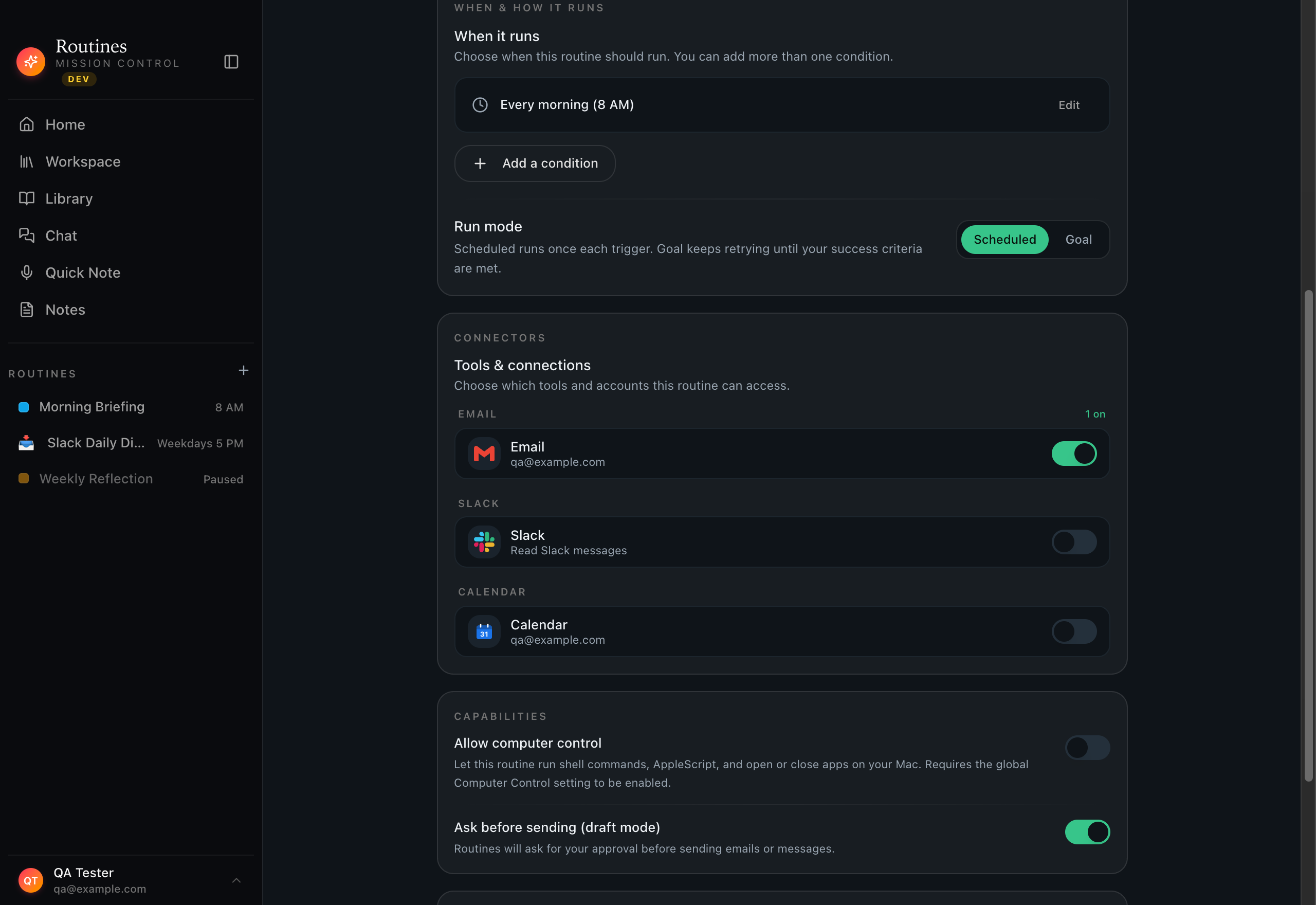
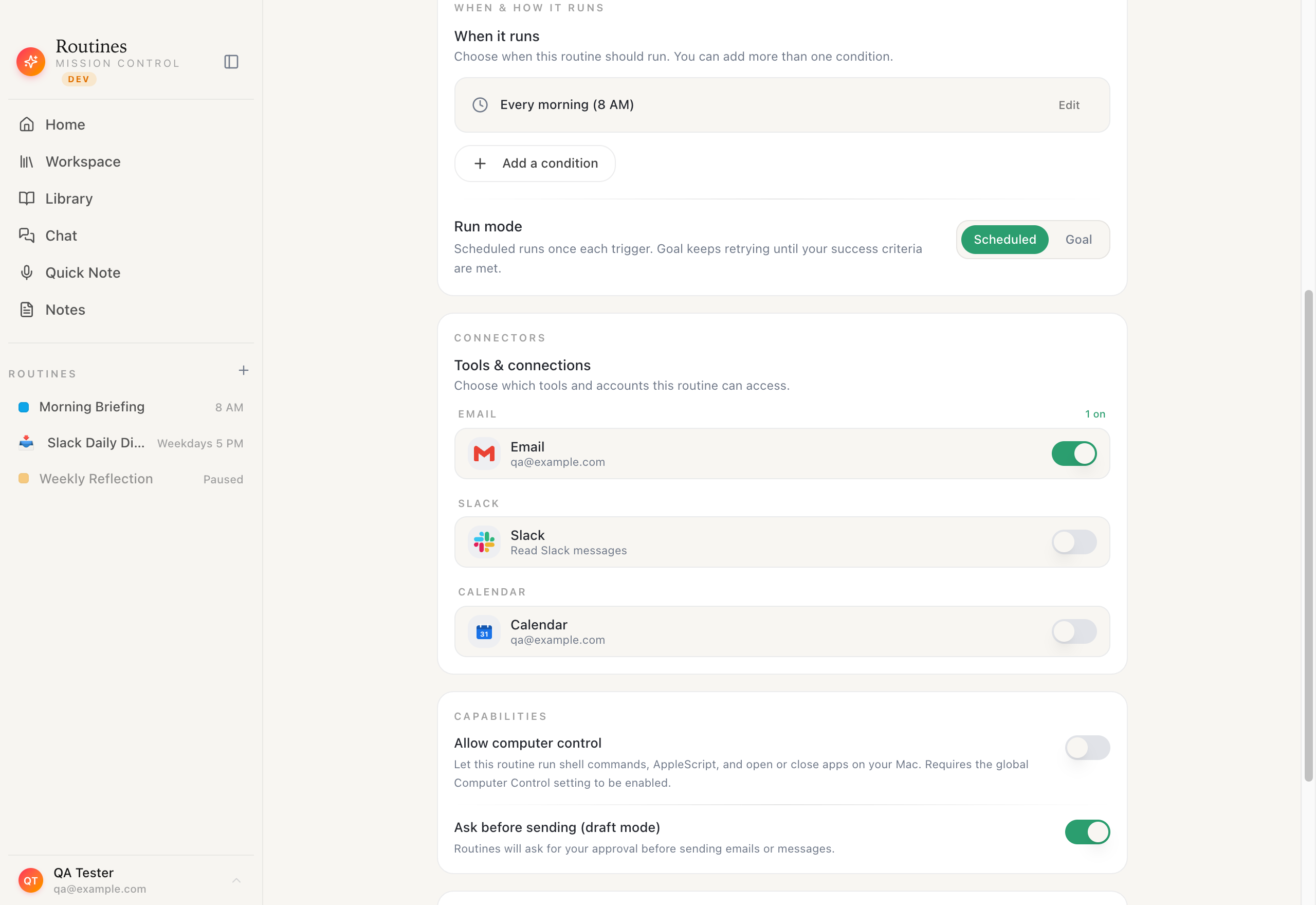
Pick when it runs — every morning, on a webhook, when your Mac wakes — and which tools it can reach: Gmail, Calendar, Slack, the browser. Flip the switches, save, and never touch it again.

The Routines builder showing a routine set to run every morning at 8 AM, with connectors for Browser, Gmail, Slack, and Calendar that can be toggled on or off

Schedule or event · pick your tools · save once

Step 03

It runs — even while you sleep.

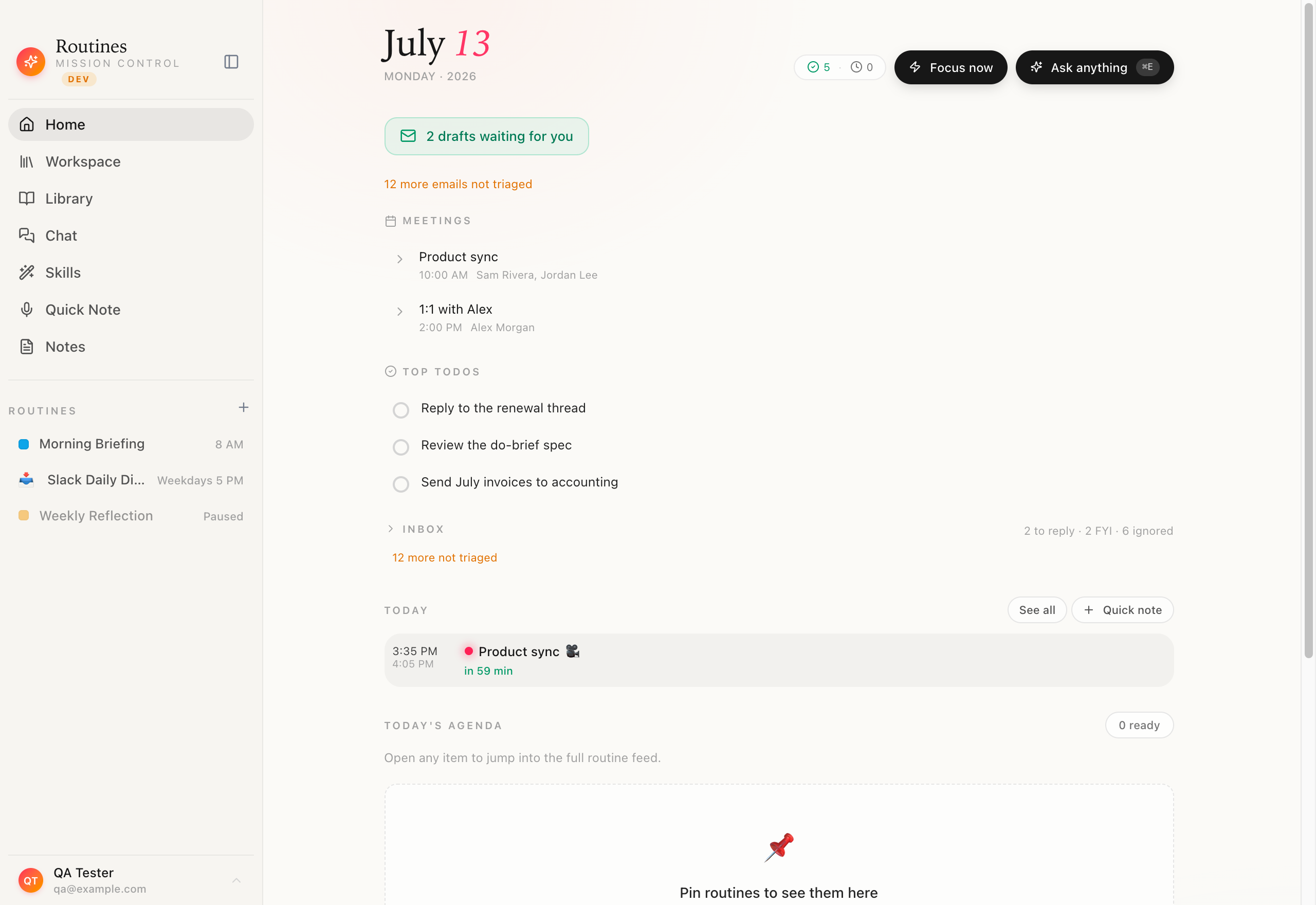
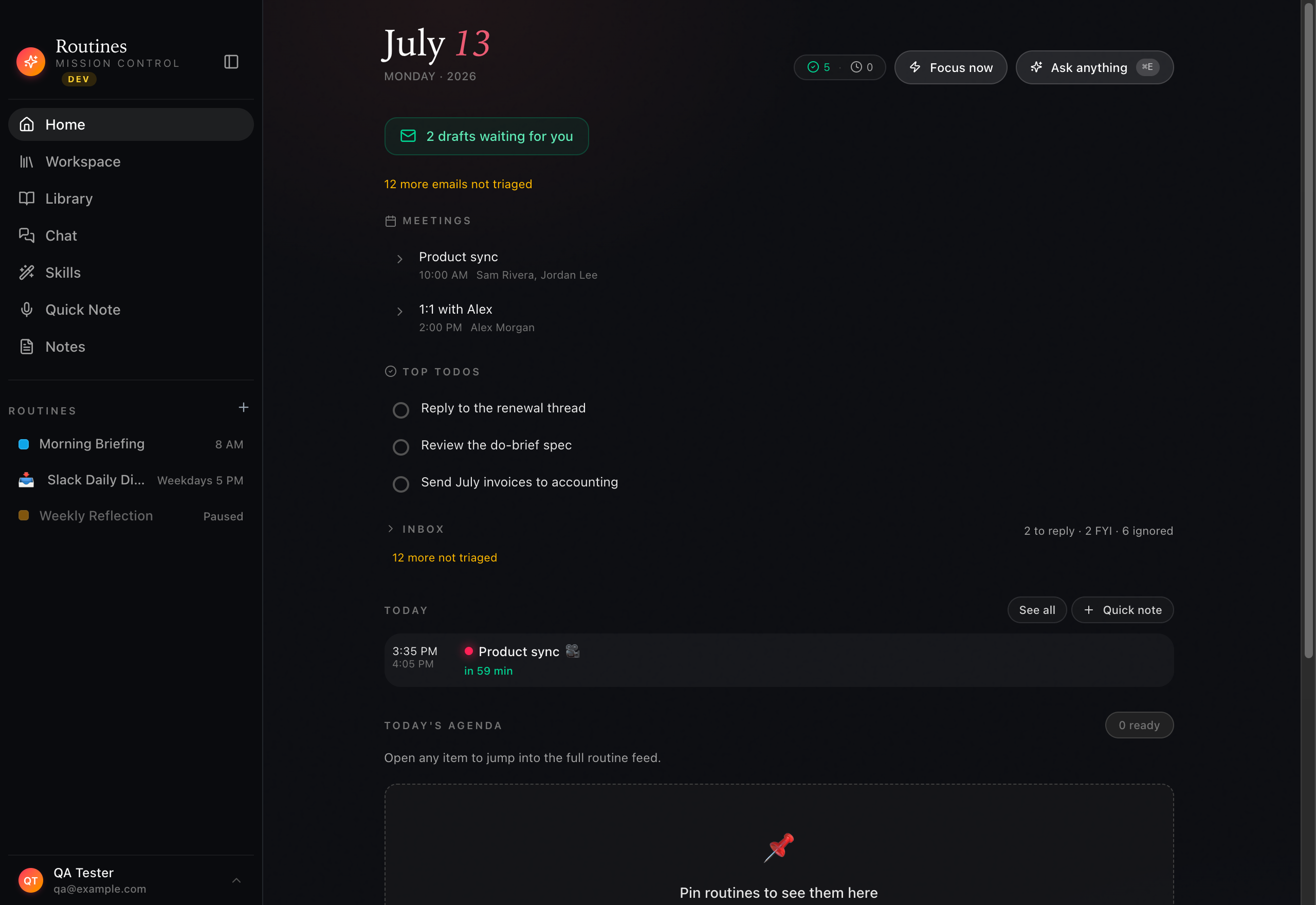
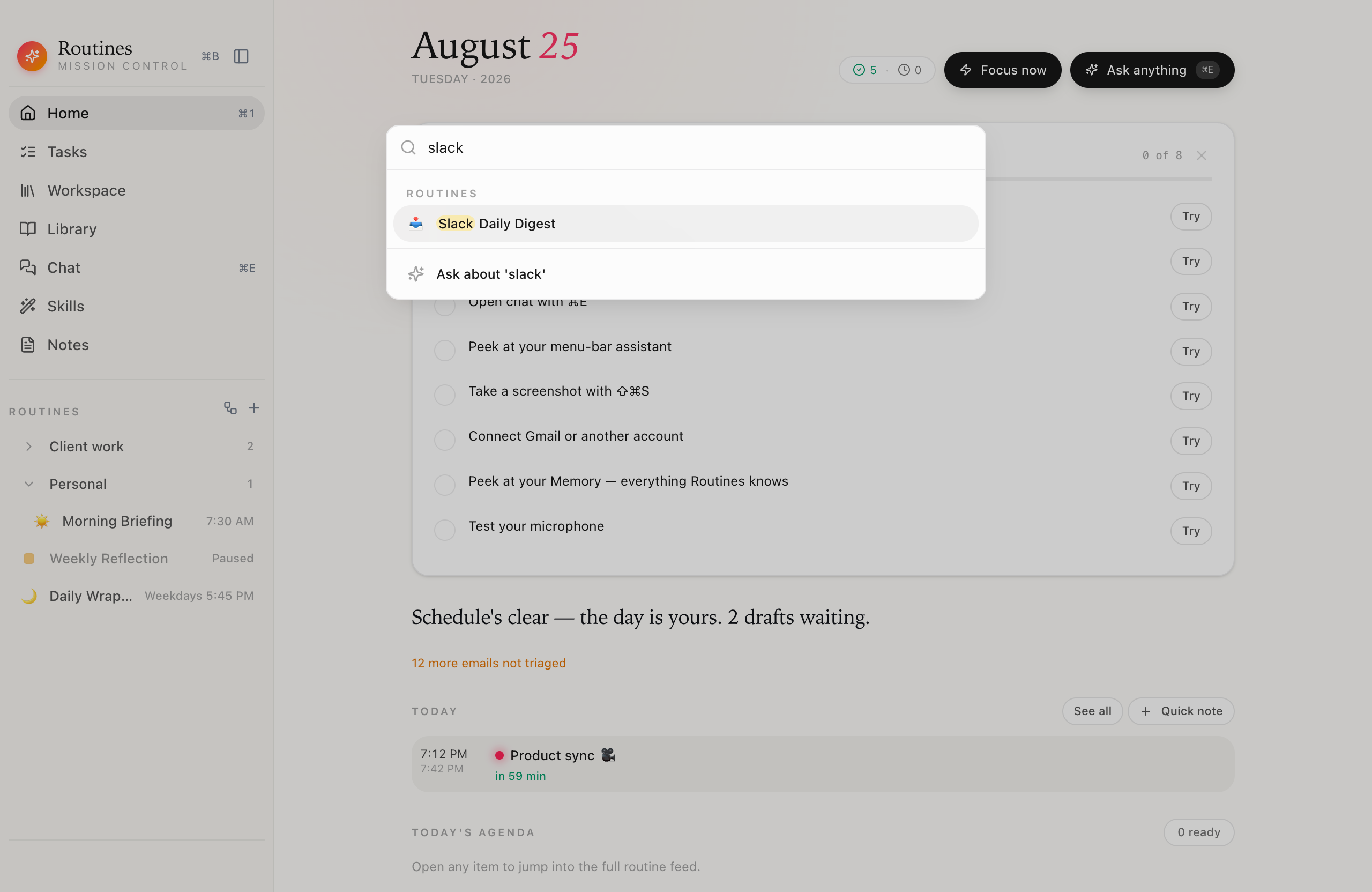
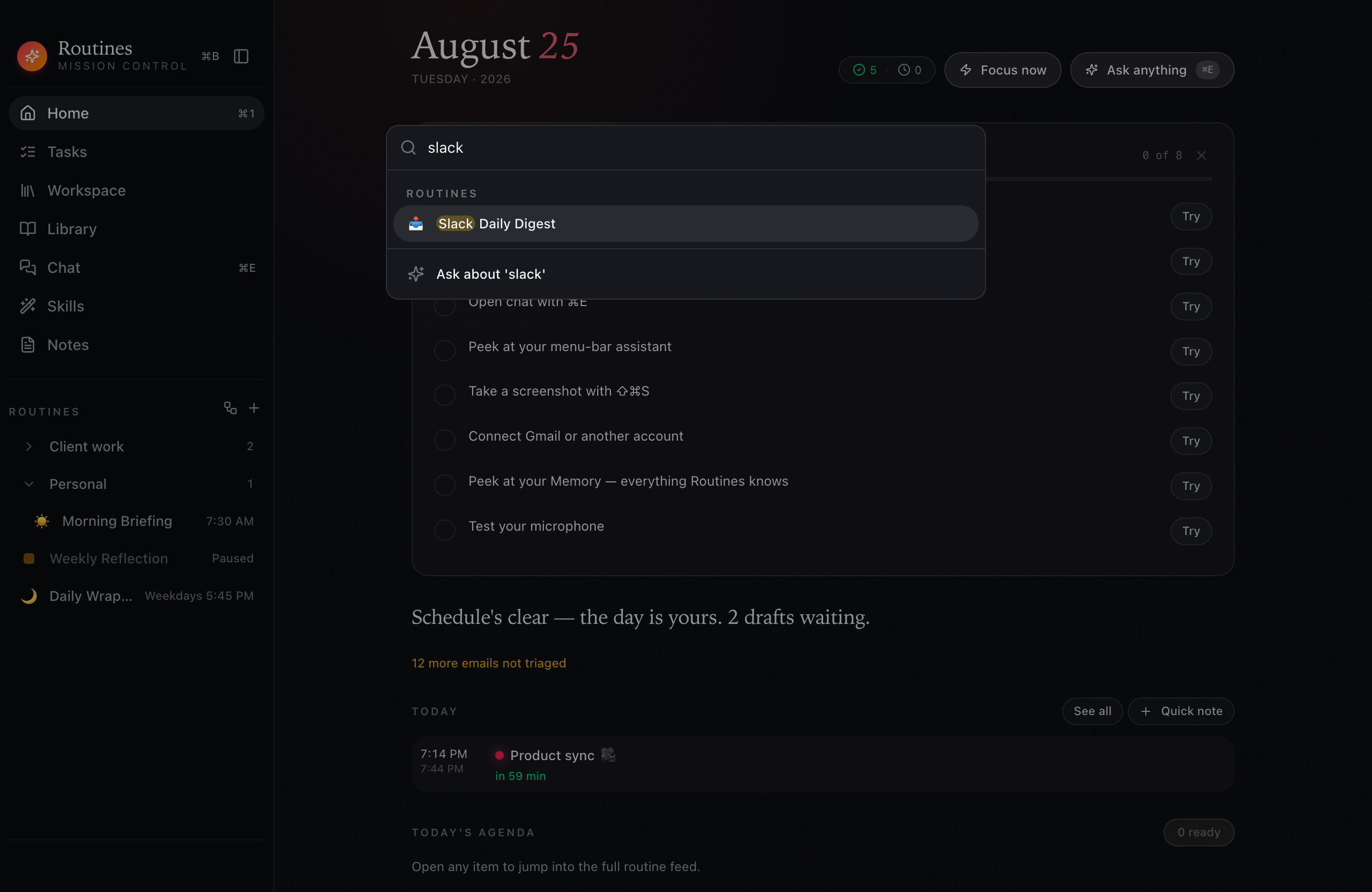
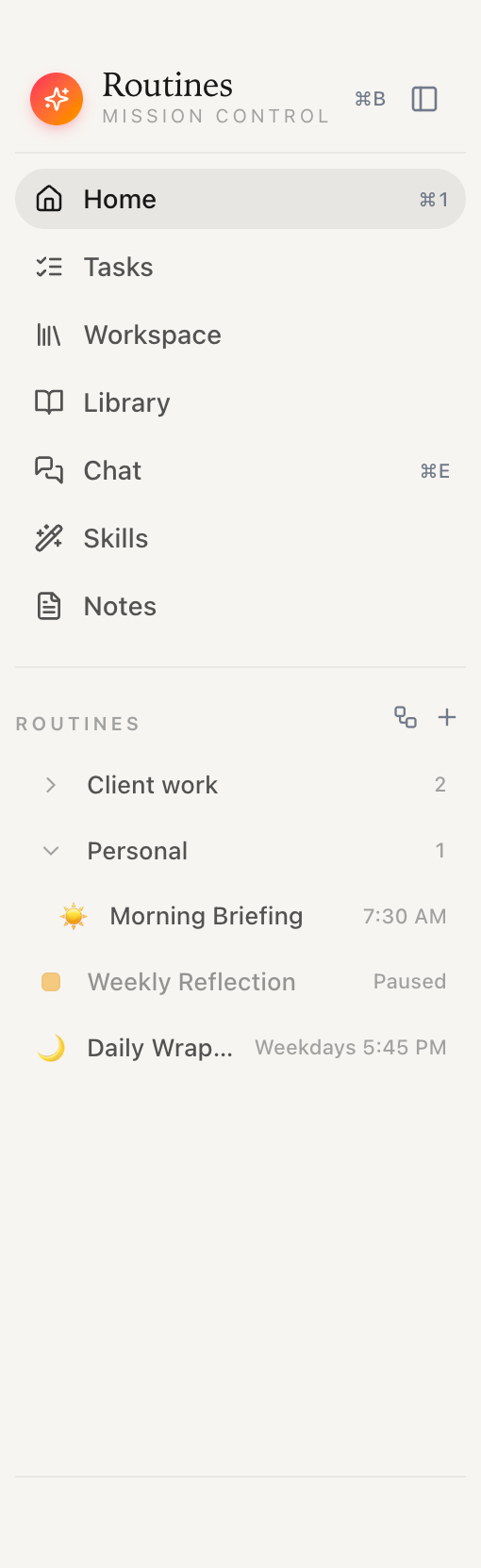
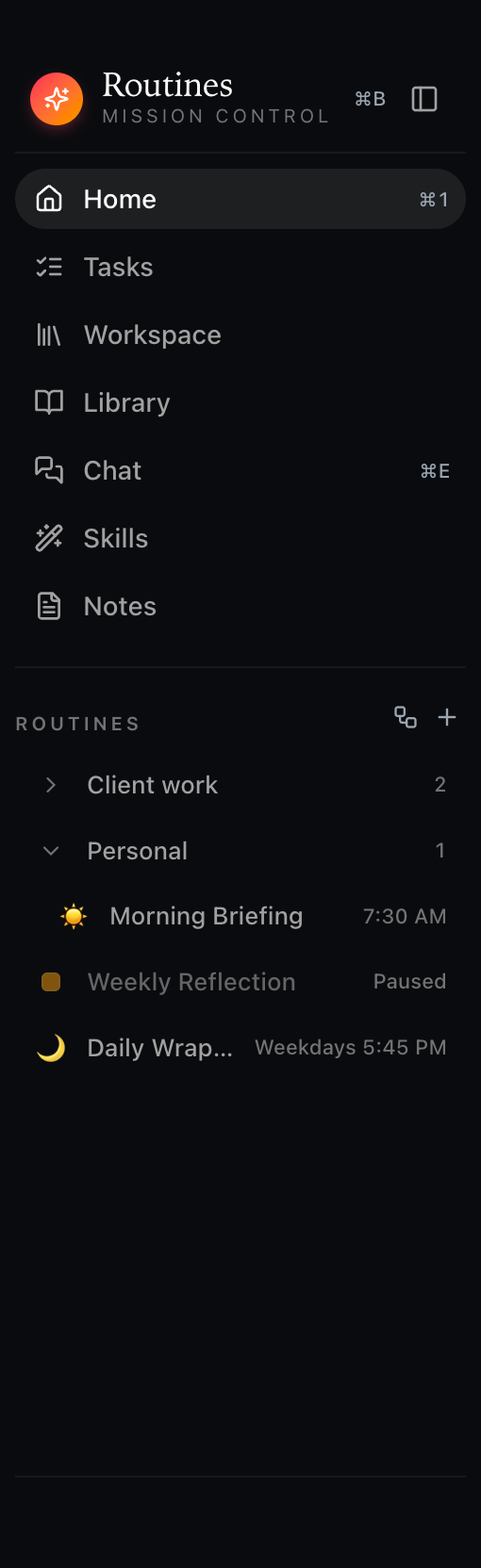
Every routine you've set lives in one place, each with its schedule and last run. Morning Briefing at 8 AM, a Slack digest in the evening, a weekly reflection on Friday — all firing on their own, all on your Mac.

The Routines home screen with a sidebar of scheduled routines — Morning Briefing daily at 8 AM, Slack Daily Digest, and Weekly Reflection — alongside the day's agenda and meetings

Every routine · its schedule · its last run

Step 04

Wake up to the result.

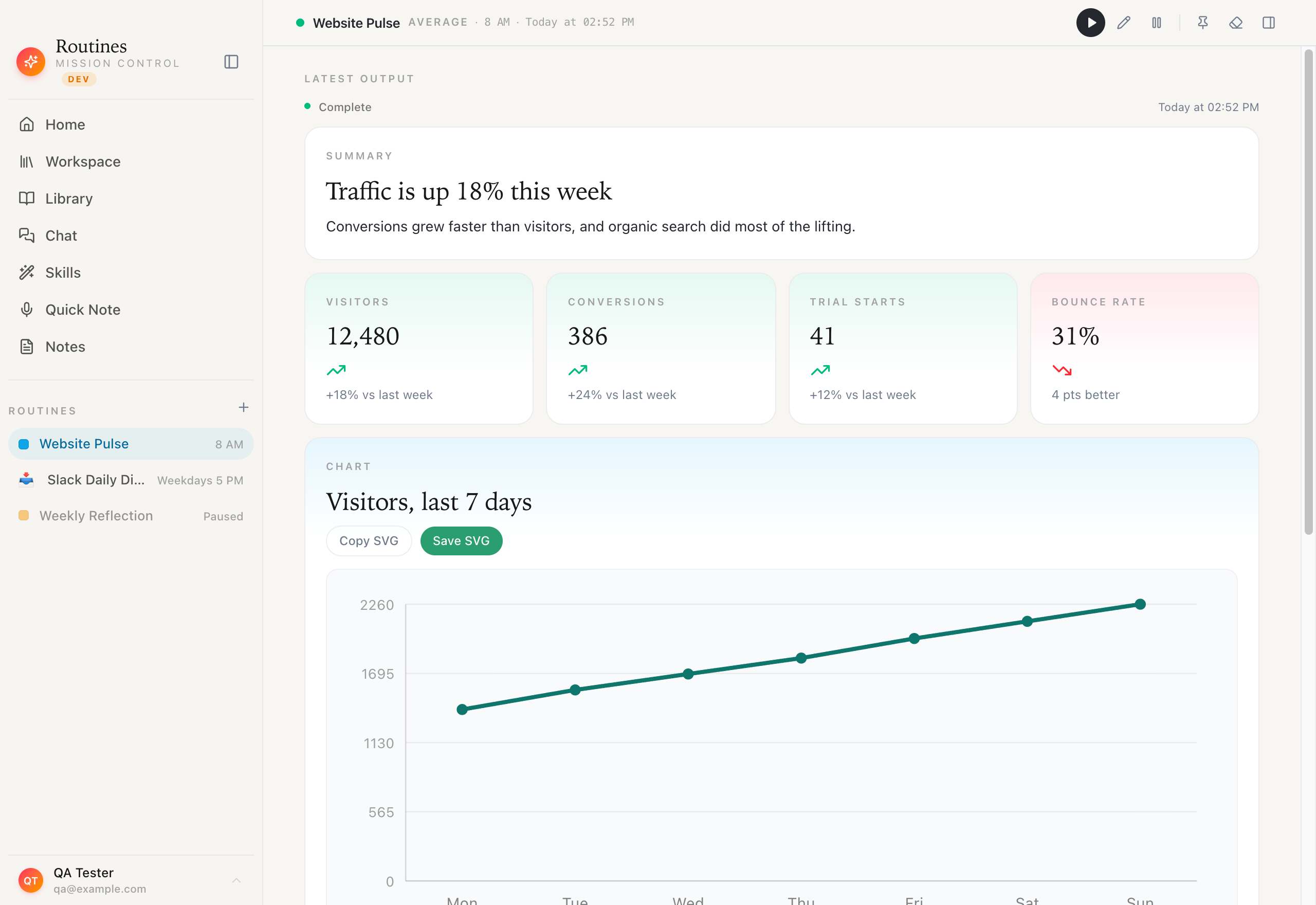
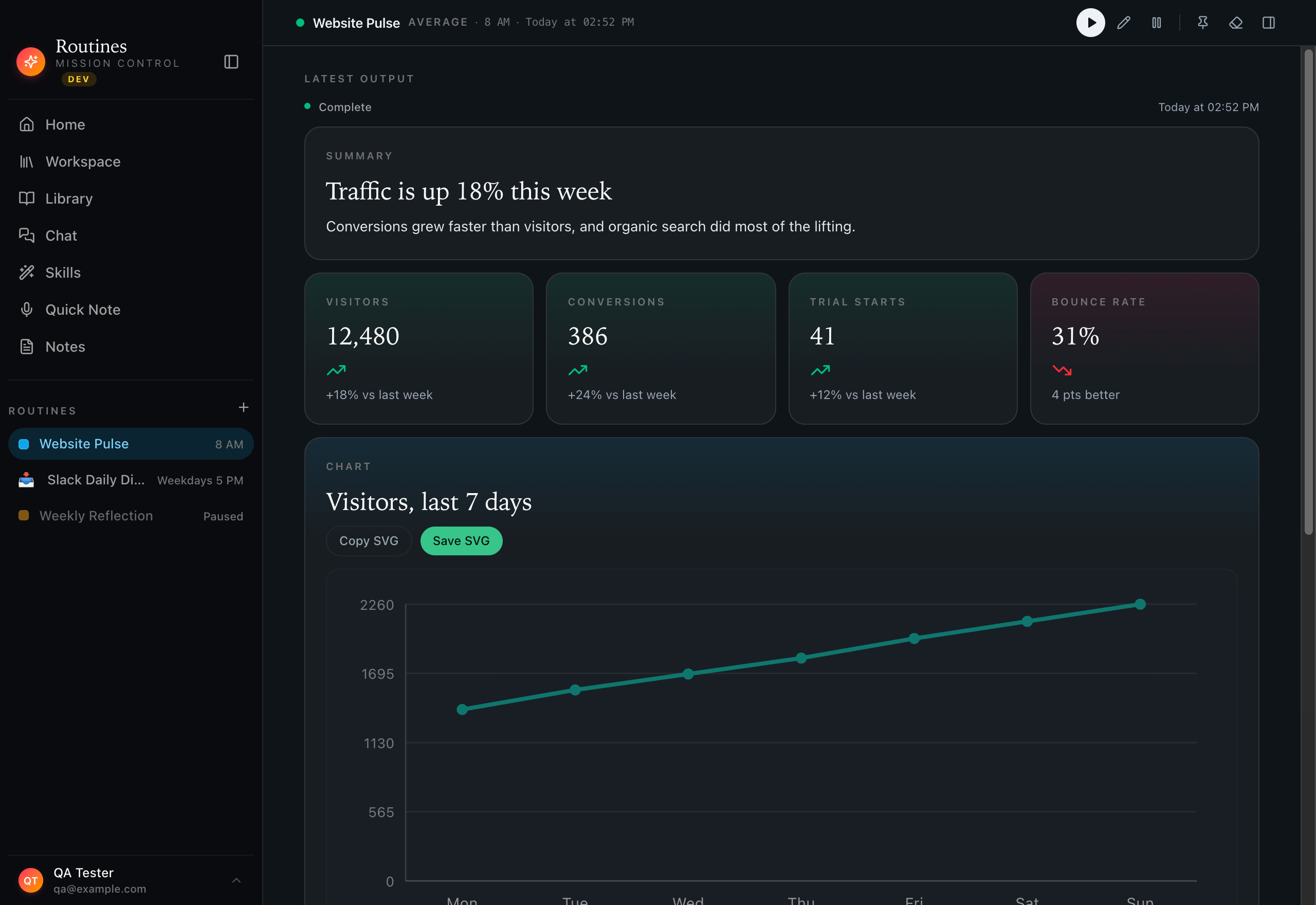
Ask how your site did overnight and wake up to a dashboard, not a paragraph: visitors and conversions with their trend, a seven-day traffic chart, the pages pulling their weight — generated by the routine as native widgets. Open it, ask a follow-up, and the whole thread stays on your Mac.

A Website Pulse routine output in Routines showing analytics widgets — visitor and conversion metrics, a weekly traffic chart, and top pages — with a chat to ask follow-up questions

Ask in plain English · Widgets out · Runs locally

Scheduled to-dos

Give a to-do a prompt and a time. Routines runs it for you.

Twice an hour, on the hour and on the half hour, a check-in sweeps the to-dos whose time has arrived. Each prompt goes through your assistant with your connectors attached, the answer lands as a new chat conversation, and a notification tells you it is waiting. It is the same live model call chat makes, on the same API key, started by a clock instead of a click.

Edit to-do

TitleReply to the Q3 renewal thread
PromptFind the renewal thread in Gmail, summarize where it stands, draft my reply.
Runs at
Today · 4:30 PMLater todayThis eveningTomorrow morning
Result landed in chat

Check-ins fire on one Mac, with Routines open. Run Routines on more than one and they fire on the Mac you pick as your Main Mac. Run check-in now works from any Mac. A run that hangs past ten minutes is recorded as failed, and a time you missed by more than a day is skipped with a notice instead of answering on stale context.

Tasks page

The list and the check-in log, on one page.

Tasks sits under Home in the sidebar, with two tabs and a third way for to-dos to arrive.

Tasks tab

Every to-do grouped by overdue, today, scheduled, upcoming, no date, and done today. The schedule row sits on each one: one-tap presets that follow the time of day (Later today, This evening, Tomorrow morning, This weekend), or an exact date and time you pick.

Heartbeat tab

Run check-in now when you would rather not wait for the next sweep, a history of recent check-ins that opens the conversation each one produced, and a behavior file (HEARTBEAT.md) the sweep re-reads before every run, so you can tell it how to work.

From your meetings

After a meeting is summarized, Routines sorts the action items by owner and adds the ones assigned to you. Items owned by someone else, or too vague to attribute, stay off the list instead of being guessed onto it.

01

Cron scheduling

Schedule routines with standard 5-part cron expressions or simple presets — daily at 8am, weekday mornings, hourly. The Rust scheduler fires jobs at the exact second and enqueues them for execution.

02

Event-driven triggers

Fire routines on real-world events: Mac wake from sleep, app launch or focus, file-system changes, incoming webhooks, global hotkeys, or the completion of another routine — chaining unlimited automation.

03

Plain-English creation

Describe what you want — "Send me a morning briefing at 8am with my calendar and emails" — and the AI parses it into a full config: name, schedule, connectors, and system prompt. No cron syntax required.

04

15-recipe template library

15 pre-built, ready-to-customize templates across 8 categories: Morning Briefing, Email Digest, Competitor Watch, Slack Digest, Weekly Report, News Scanner, and more — each with sensible default schedules.

05

Run Now

Run any routine on demand with one click, regardless of its schedule. Perfect for testing before automating or grabbing a report this instant — no waiting for the next scheduled run.

06

Smart queue & retry

Routines run through a single queue with up to 4 executing in parallel, governed by a semaphore. Network-dependent failures auto-retry after five minutes — your automations finish even when the network stumbles.

07

Never-miss catch-up

On app startup and Mac wake, Routines checks whether any scheduled runs were missed while closed or asleep — and runs them retroactively, flagged so you know they ran late. Your 8am briefing still arrives.

08

Beautiful output history

Every run produces a result record with status, content, errors, and timestamps — rendered as rich, specialized cards: summaries, weather, calendars, email digests, news, and charts, organized by date.

Your automations. Your Mac. Your data.

Routines schedules, triggers, and runs every automation on your own Mac, with no server fees and no per-run charge. The model call is the one step that leaves: through Routines AI, which never stores it, or straight from your Mac to your provider on your own key. When you want to change how one behaves, here is how to customize a routine on your Mac.

Download