02 / Meetings

Your meeting, written down. While it happens.

Routines notices the call, records it on one click, transcribes it live — and answers your questions before the meeting even ends. See how it sits next to the rest of the field in our roundup of the best AI note takers.

Step 01

A meeting starts. Routines notices.

Weekly Product Sync

Google Meet

Start recordingNot now
Don't ask again for Google Meet

Step 02

The transcript flows like iMessage.

Weekly Product Sync

14:38Pause
14:02
Ana
Can we ship the beta on Friday?
Yes — pending the notarization fix.
Mihai
I'll own the release notes and the changelog.
14:04
Ana
Great. Action item: Eduard signs the build.
Done. Recording this so nobody takes notes.

Step 03

Ask AI — while it's happening.

Summarize so farWhat did I miss?Make me sound smart
What did I miss in the last 10 minutes?
Ana proposed shipping the beta Friday — the only blocker is notarization. You own signing the build; Mihai owns the release notes.
Ask about this meeting…

Step 04

Hang up. Send the notes to Slack.

Send the meeting notes to #product on Slack
#product

Notes posted to #product

Summary · decisions · 3 action items

Recorded locally · live transcript · chat with your meeting

The real app

Not a mockup. This is the app you download.

Real screens, captured straight from Routines on a Mac. Every transcript, summary, and note below lives in local storage on your machine.

Live, mid-meeting

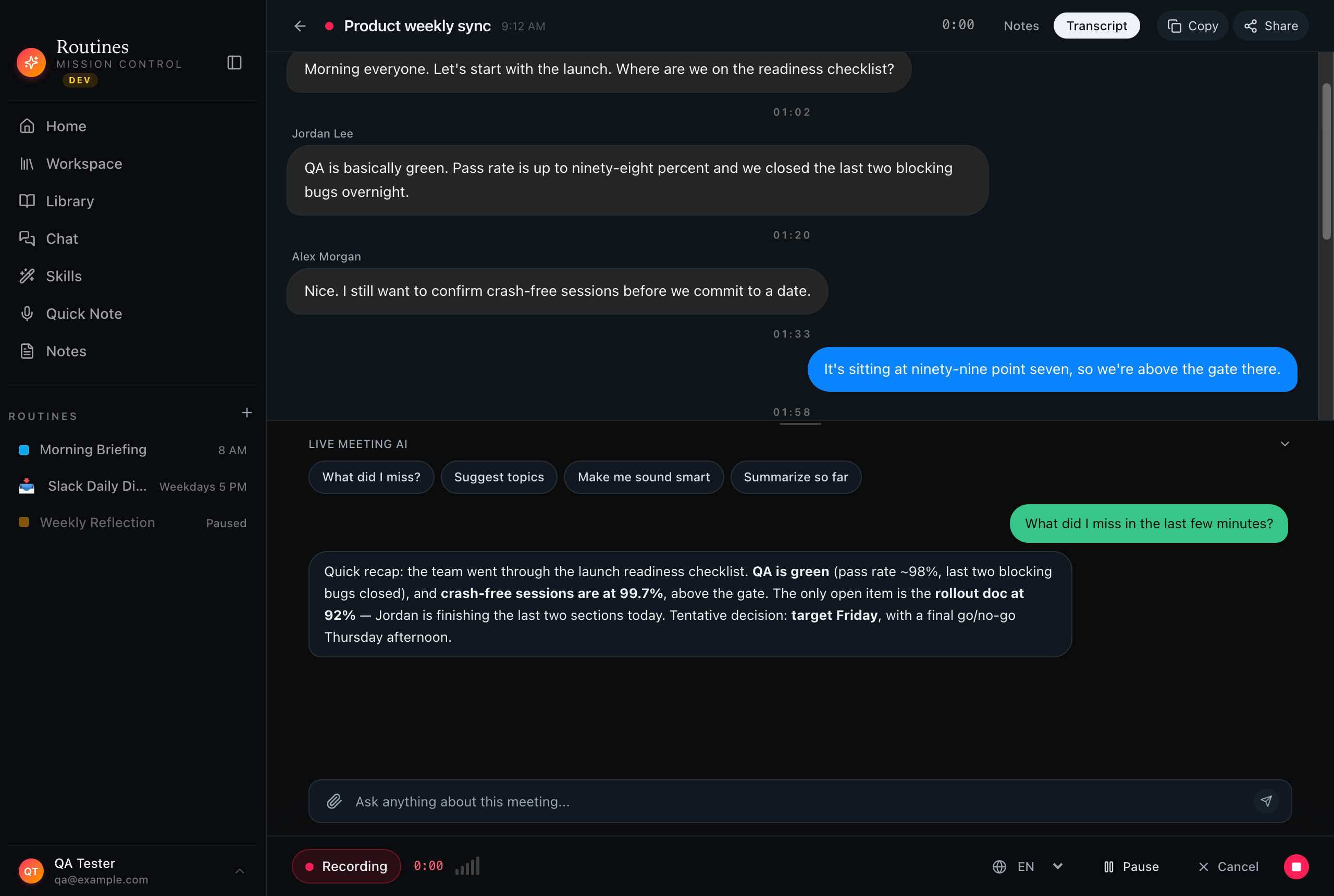
Ask the meeting a question while it's still going.

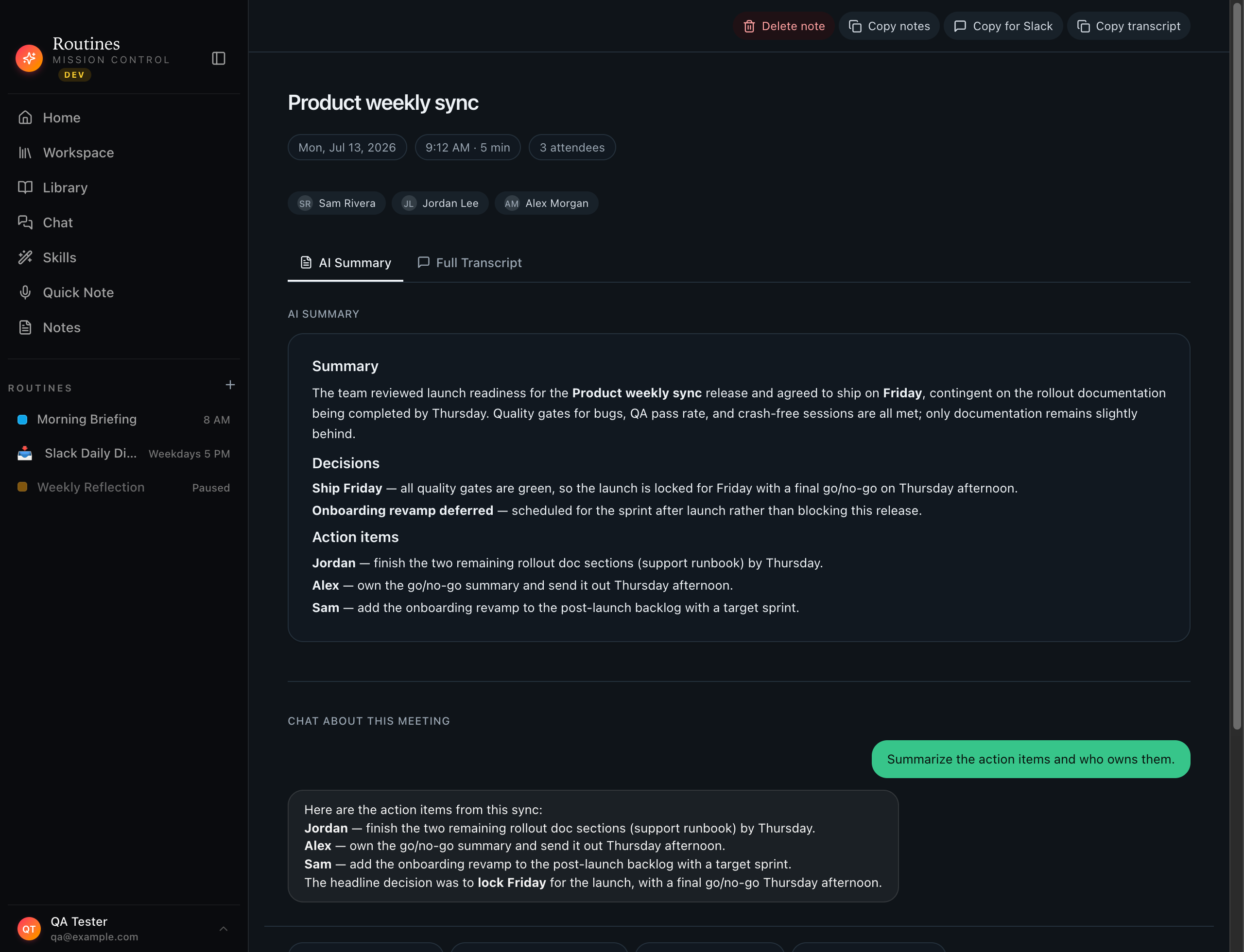
The transcript streams in as people talk. Pop open the chat, ask "what did I miss?", and get a straight answer in seconds, without leaving the call or pausing the recording.

Routines recording a meeting called Product weekly sync, with a live transcript and the Live Meeting AI chat answering the question what did I miss in the last few minutes

Live transcript · ask anything · still recording

Drop in a screenshot

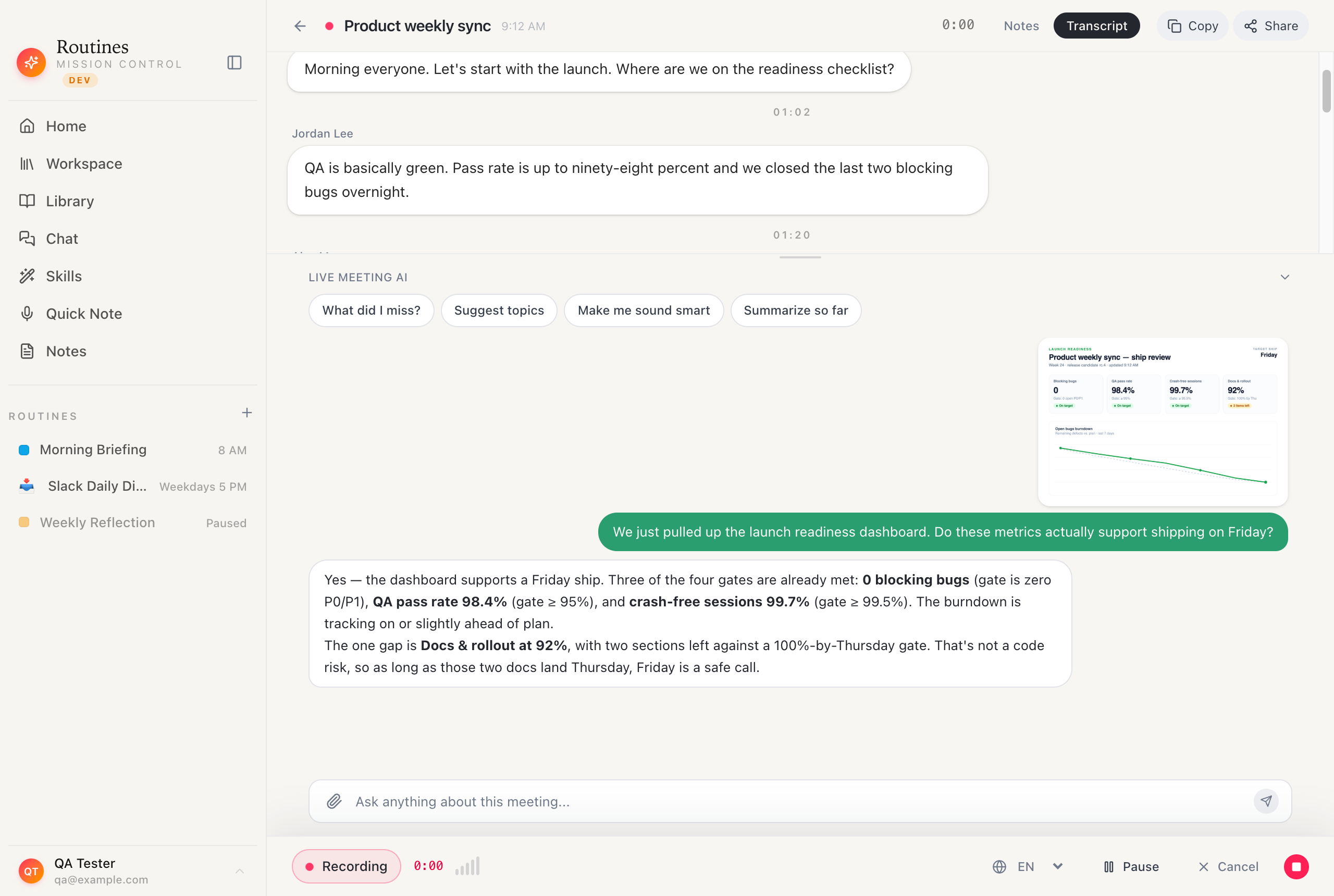
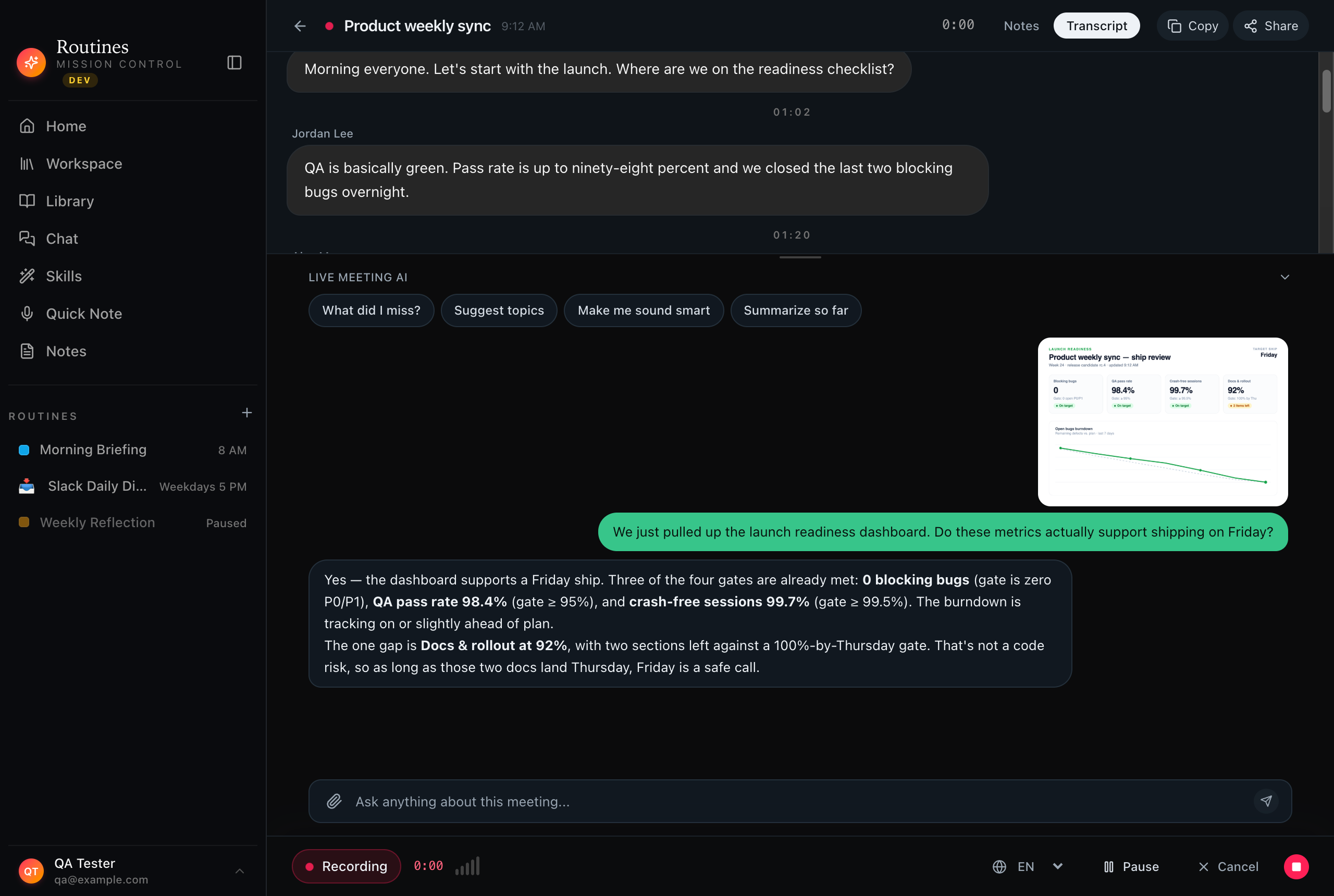
Paste a chart. Ask about it on the spot.

Someone shares a dashboard or a slide in the call? Paste or drop the image straight into the meeting chat. Routines reads it alongside the transcript and answers in context.

Routines meeting chat with a launch readiness dashboard image attached, and the AI reading the chart to answer whether the metrics support shipping on Friday

Paste or drop an image · the AI reads it · answers in context

After you hang up

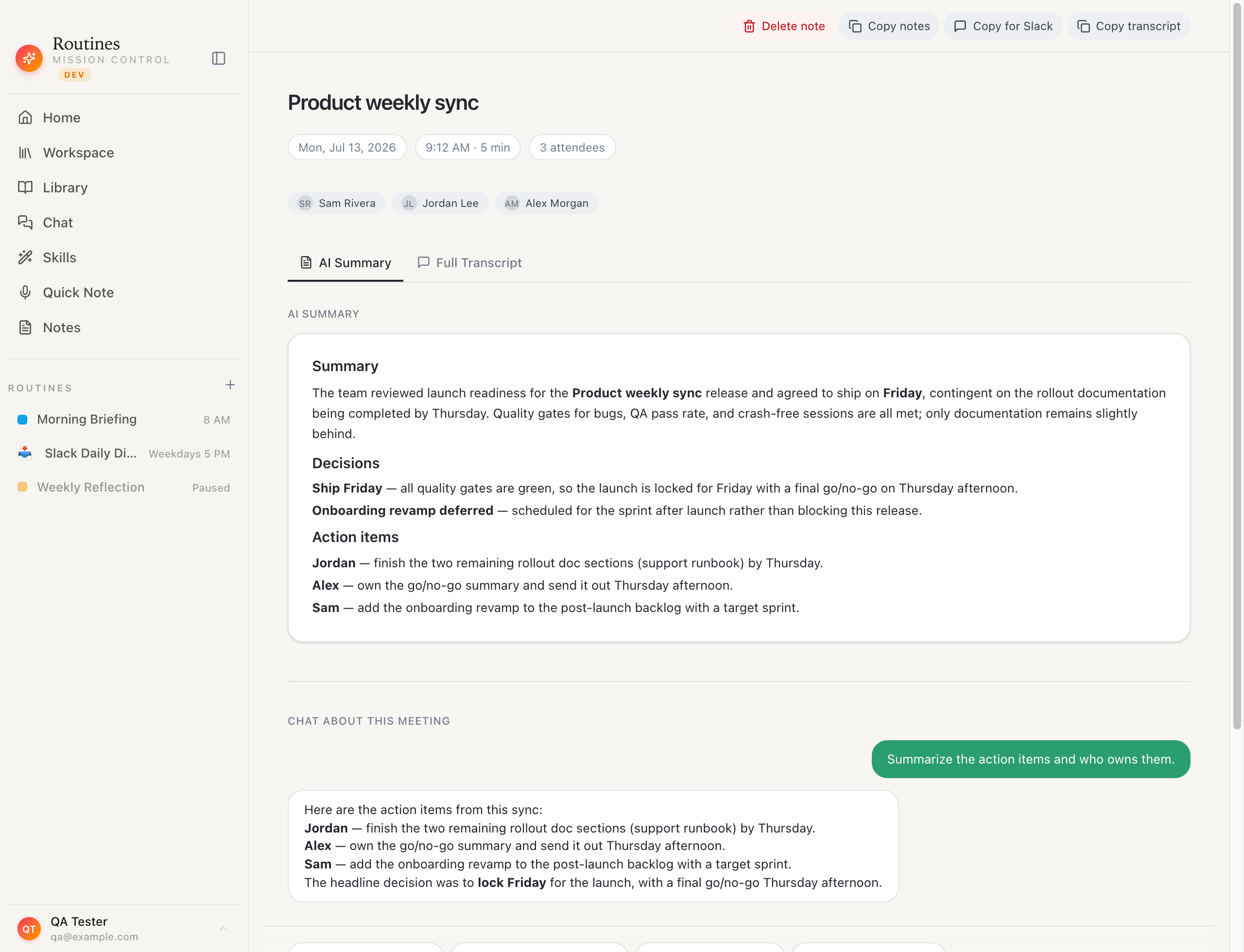
Summary, decisions, action items. Written for you.

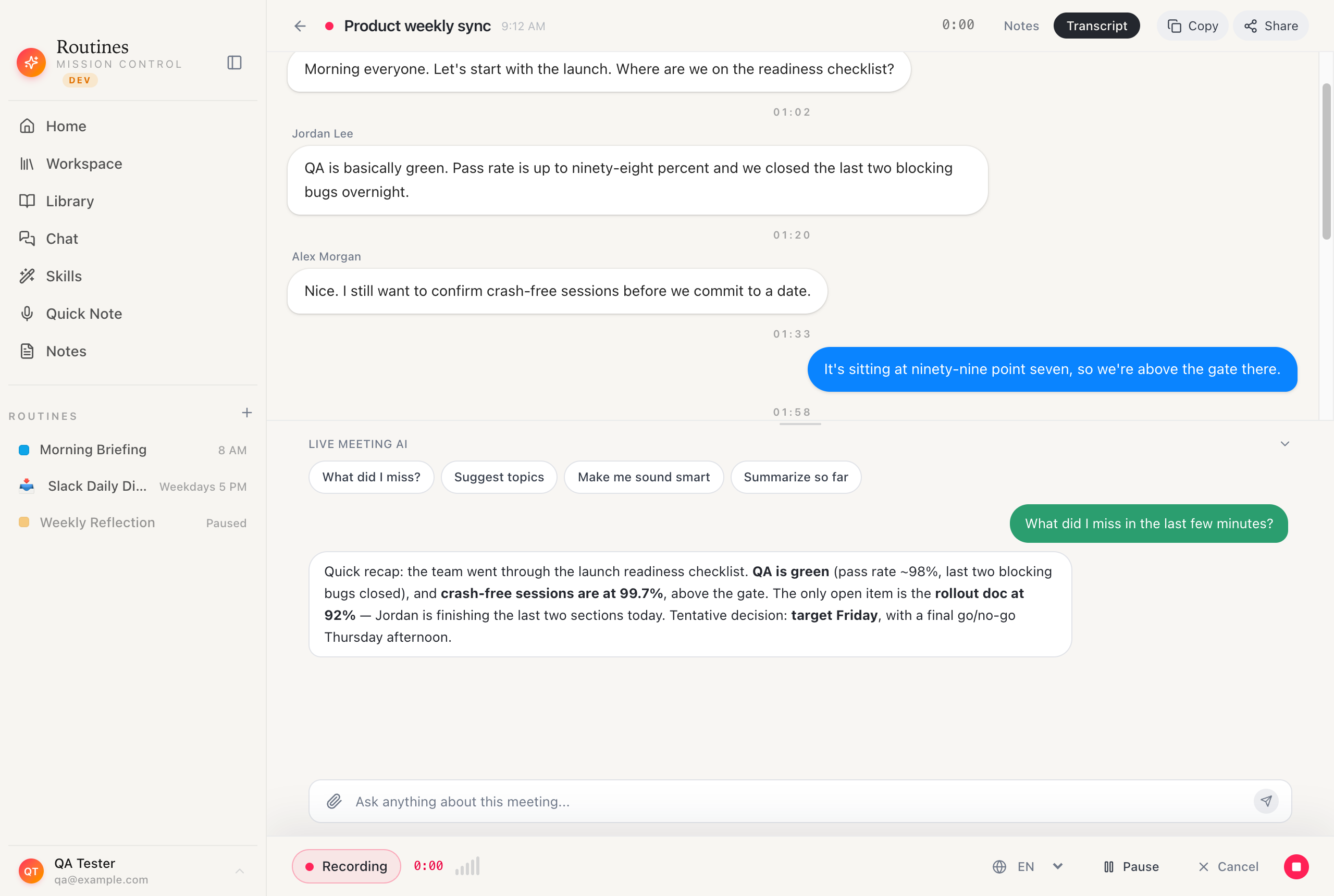
Stopping the recording hands the app straight back to you, and the one-pager lands on the meeting once it is written: summary, the decisions, who owns what. The full transcript sits one tab away, and you can keep chatting with the meeting or save it into your notes. It is stored as files on your Mac, not in an account you have to keep paying for.

A finished Routines meeting called Product weekly sync showing the AI summary with decisions and action items for Alex, Jordan, and Sam, plus a chat about the meeting

AI summary · action items · saved as local markdown

Forgot to stop it? It asks.

After about an hour of recorded audio, Routines checks in with two buttons: keep recording or stop. It waits for a quiet moment in the call rather than cutting in mid-sentence, and if nobody answers, it stops the recording about ten minutes later and writes the notes as usual. Past three hours of recorded audio it asks no matter how lively the call is, and every Keep, before or past that mark, buys about another half hour before the next check-in.

Regenerate the notes

Not happy with the summary? Ask Routines to regenerate the notes on any finished meeting and it writes a fresh one-pager from the stored transcript. If the rewrite fails, your old notes stay untouched. Only the summary step is re-run: the audio behind the transcript is deleted once the meeting is written up, so a word the transcription got wrong stays wrong in the new notes too.

Stop is instant

Hang up and move on. The notes finish themselves.

Stopping ends the recording and gives you the app back on the spot. The meeting joins a queue that runs in the background and writes the summary while you get on with the day.

01

The next call can start now

The recorder is free the moment you stop, so a back to back meeting starts recording while the last one is still being written up. Summaries are written one meeting at a time, so the second one waits behind the first.

02

The list tells you it is working

Until the summary is done, the meeting carries a "Generating notes…" line in your meeting lists on the homescreen and in the menu bar. That status sits on the meeting itself, so you can walk off to another screen and come back to it.

03

Quitting mid write-up costs nothing

The recorded audio stays on disk until the meeting is finished being written up. Quit or crash in the middle and Routines picks the meeting back up on the next launch, running the write-up again from the start. If the write-up itself dies, the meeting is flagged so you can run it again.

Instant stop · background queue · resumes after a quit

01

One-click recording

Routines watches your calendar and your screen — when a Meet, Zoom, Teams, or Slack huddle starts, it offers to record. One click and the transcript begins.

02

Everyone, attributed

Your mic and the room are captured as separate streams — "You" vs every other speaker, echo-filtered, in real time.

03

Ask AI mid-meeting

The chat reads the live transcript. "What did I miss?" "Who owns this?" — answers in seconds, without leaving the call.

04

Send notes anywhere

When you hang up, ask the chat to post the summary and action items straight to Slack, email, or Jira via your connectors.

05

AI summary & action items

Recording stops, Claude writes the one-pager: key points, decisions, owners — stored next to the transcript.

06

Where your audio goes

Meeting audio streams to Deepgram for transcription, on the key we manage if you are on Pro or in the free trial, or on your own Deepgram key on the Free plan.

07

Resilient recording

Checkpointed to disk every 5 seconds — survives crashes. Pause, resume, or hot-swap the language mid-call.

08

Local meeting library

Every transcript, summary, and note lives in local SQLite, full-text searchable, and stays on your Mac unless you turn on Cloud Sync.

Questions about calls and the iPhone

Can Routines record a Google Meet or WhatsApp call on my iPhone?
No, and no app can. While another app runs a call on the iPhone, iOS does not hand that call's audio to any third-party app: not the other participants, and not your own microphone for the duration of the call. This applies to Google Meet, WhatsApp, FaceTime, Zoom and Teams alike, and no setting changes it. We measured it on a current iPhone and Apple's developer support confirms there is no supported way around it. Routines tells you so on the spot instead of quietly saving an empty transcript.
How do I record a Google Meet call, then?
Join the meeting from your Mac and press Record in Routines. The Mac app captures both sides, your microphone and the call audio, separates the other speakers, and transcribes everything locally. If you were on the phone, ask the host for Meet's own recording or transcript and import it into Routines, or put the call on speaker and record it with a second device nearby.
What does the iPhone app record?
In-person meetings, dictation and voice notes through the microphone, and recordings from Apple Watch. They are transcribed and sync back to the Mac app, where the summaries, action items and chat live. Calls carried by other apps are the one thing an iPhone app is not allowed to hear.

Stop taking notes by hand.

Routines records, transcribes, and answers — while your data stays exactly where it belongs. If Granola is the tool you are weighing, read our Granola AI review or the side-by-side Routines vs Granola comparison first.

Download